Arabic & English Shapes Flashcards: A Bilingual Learning Tool
Building a brand or creating educational materials that resonate with a global audience requires more than just translation; it demands a cohesive visual language. For designers, educators, and entrepreneurs working within bilingual contexts—specifically bridging English and Arabic—finding design assets that are both functional and aesthetically pleasing can be a challenge. The Arabic & English Shapes Flashcards offer a practical solution, moving beyond standard text to provide a tangible learning experience wrapped in modern, customizable templates.
Beyond Basic Typography: Visual Learning with a Bilingual Twist
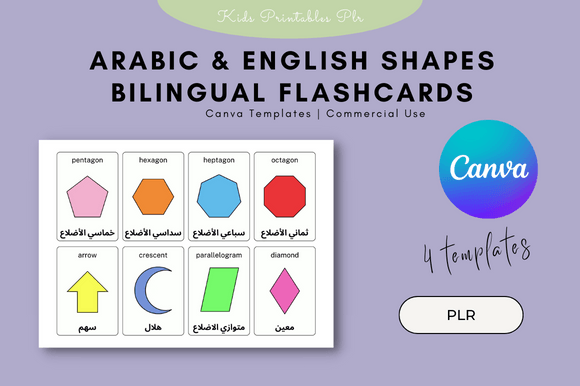
While typography focuses on letterforms, design often requires stepping back to look at the bigger picture—literally. These flashcards focus on fundamental geometry: the square, circle, rectangle, and triangle. However, their value lies in their dual-language capability. In the realm of modern typography and brand identity, consistency is key. If you are a publisher or content creator producing materials for a diverse demographic, you cannot afford to have mismatched visual styles between your English and Arabic assets.
These templates serve as a bridge. They are not just static images; they are design assets built for interaction. The inclusion of tracing and coloring pages transforms a passive viewing experience into an active motor skill exercise. For a preschool teacher or a homeschooling parent, this dual functionality is invaluable. It combines the cognitive recognition of shape and language with the physical act of tracing, which aids in memory retention.
From a visual perspective, the flashcards possess a clean, friendly personality. They avoid the clutter that often plagues educational printables. This simplicity is a strategic advantage. It ensures that the learner focuses on the shape and the word, rather than being distracted by excessive ornamentation. For the graphic designer or hobbyist, this clean slate is an invitation. It allows for customization without fighting against existing complex layouts.
Practical Applications for Creative Professionals
Understanding where to deploy these assets is just as important as having them. The versatility of the Arabic & English Shapes Flashcards extends far beyond the classroom. Here is how different segments of the creative market can leverage this resource:
- Small Business Owners & Packaging: If you own a business that caters to Middle Eastern markets or bilingual communities, your packaging needs to speak both languages fluently. Using these shapes as background elements or icons on packaging can soften the brand's image, making it more approachable and family-friendly. The square and circle motifs are timeless in packaging design.
- Content Creators & Social Media Graphics: Engagement on platforms like Instagram and Pinterest often relies on educational content ("Edutainment"). A content creator could use these templates to create a series of "Word of the Day" posts. The ability to change colors allows the creator to match the flashcards to their specific brand identity or seasonal themes.
- Web Designers & UI Elements: In web design, user interface icons often need to be simple and universally understood. The vector-friendly nature of these templates (via Canva) means a designer can extract a triangle or rectangle and use it as a button background or a section divider, ensuring the site maintains a cohesive visual hierarchy.
- Print on Demand & Editorial Design: For those in editorial design, such as creating workbooks or magazines, the tracing and coloring pages offer ready-made content for activity sections. They reduce the production time significantly, allowing the publisher to focus on layout and flow rather than drawing basic geometry from scratch.
Customization and Font Strategy in Canva
The fact that these are 4 templates for Canva Free is a significant logistical benefit. Canva democratizes design, allowing entrepreneurs and marketers to execute high-level concepts without needing Adobe Creative Cloud expertise. However, the true power of these flashcards lies in the customization of the typeface.
When you open the template, you have the freedom to alter the font choice. This is where your brand strategy comes into play. The default font is likely a friendly sans serif font or a rounded script font to appeal to children. However, consider your specific audience:
- For a Corporate Educational Toy Brand: You might want to swap the playful font for a cleaner, geometric sans serif font. This projects professionalism and safety, key selling points for parents.
- For a Boutique Stationery Line: If you are selling these as printable art rather than just learning tools, you might introduce a handwritten font or an elegant serif font for the English text to elevate the aesthetic. However, always ensure the Arabic script maintains its legibility and cultural appropriateness.
Color psychology is another lever you can pull. A circle is naturally inclusive and soft; pairing it with warm tones like terracotta or soft yellow enhances that feeling. A triangle is dynamic and directional; using bold colors like electric blue or red can emphasize its energy. Because the templates allow color changes, you can create multiple sets that target different age groups or learning stages.
Evaluating Fit and Hierarchy
Before committing to a design asset, it is wise to evaluate how it fits into your broader visual ecosystem. Ask yourself: Does the visual weight of the shapes balance well with the text? In bilingual design, particularly with Arabic and English, you are dealing with two distinct scripts. Arabic reads right-to-left, while English reads left-to-right. This requires careful attention to visual hierarchy.
The Arabic & English Shapes Flashcards generally handle this by centering the shape and the text, creating a neutral composition that works regardless of reading direction. This is a smart design choice that prevents the layout from feeling lopsided.
Furthermore, consider the readability of the text against the background. If you decide to change the background colors, ensure there is sufficient contrast. A dark blue rectangle with black text will fail basic accessibility standards. Use tools within Canva to check contrast ratios if you are unsure.
Ultimately, these flashcards are more than just a list of shapes. They are a versatile creative font and layout playground. They provide the structure needed for effective learning while offering the flexibility required for sophisticated logo design elements, social media content, and branded merchandise. By utilizing the tracing features and customizing the templates to fit your specific visual voice, you create a product that is both educational and commercially viable.